Exploring the Mysteries of Milling Cutters: Equal vs. Unequal Flutes and Equal vs. Unequal Helix Designs
In the realm of metalworking and machinery manufacturing, milling cutters, as indispensable cutting tools, have their types and designs directly related to machining efficiency and the quality of finished products. Today, let's delve into two major classifications of milling cutters—equal-flute and unequal-flute designs, as well as equal-helix and unequal-helix designs, unveiling their unique charm and application value in industrial production.
Equal-Flute vs. Unequal-Flute Designs

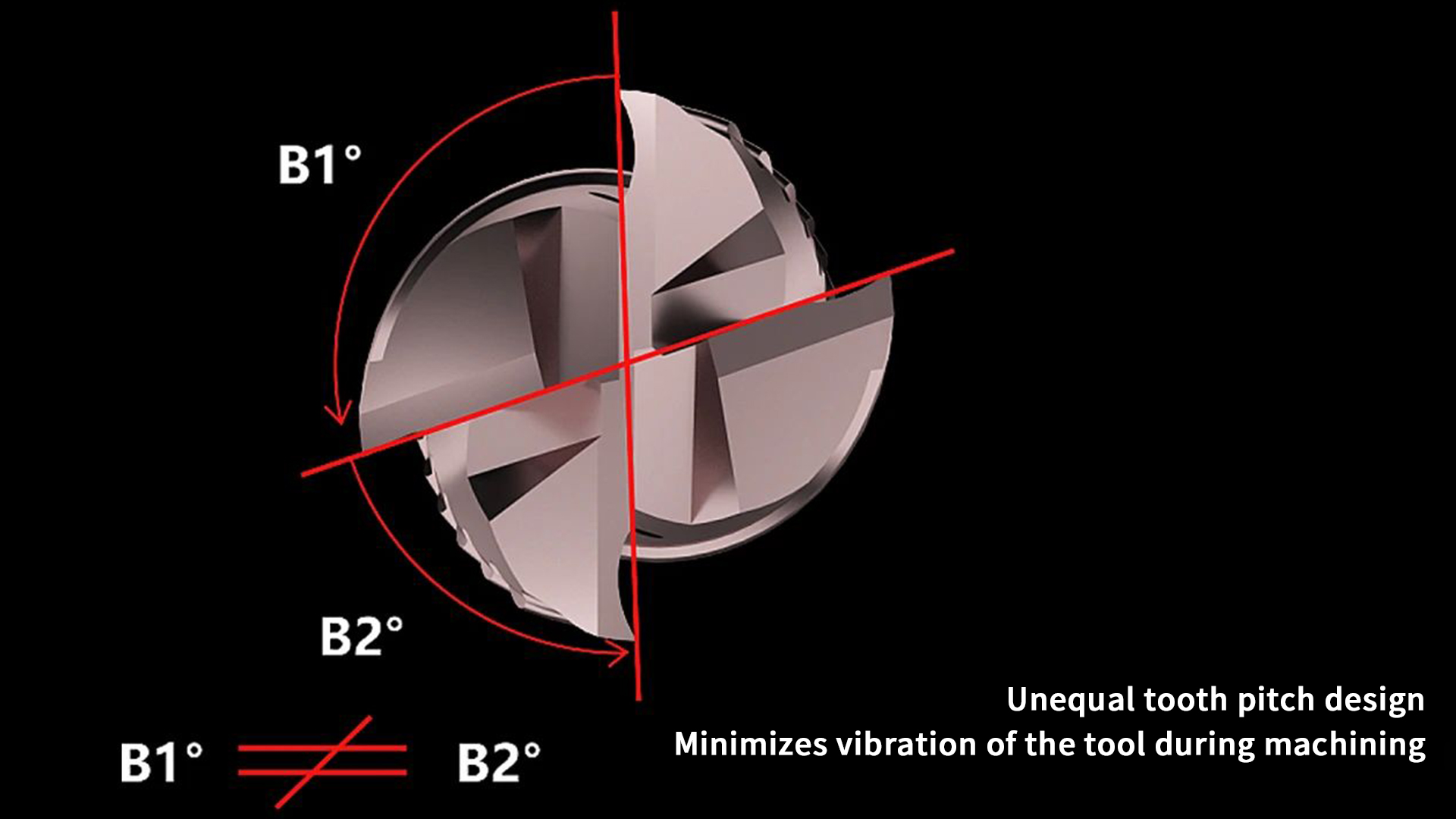
Unequal-Flute Design
Characteristics: The flute pitches are unequal, with varying spacing between each cutting edge, typically achieved through randomly distributed inter-flute angles. The teeth of the cutter are not arranged in a uniform sequence, resulting in different loads and angles experienced by each tooth during cutting.
Advantages:
- Reduced Vibration: Due to the unequal flute pitches, the cutter minimizes resonance effects during cutting, thereby reducing vibration.
- Improved Surface Finish: The unequal-flute design helps reduce vibration, leading to an enhanced surface finish of the machined part.
- Higher Cutting Efficiency: With varying intervals between cutting edges, unequal-flute cutters can operate at higher cutting parameters, ensuring smoother cutting.
Applications: Suitable for high-precision machining requirements, such as in the aerospace and automotive component industries. Particularly effective for machining high-hardness materials like stainless steel and titanium alloys, as it better handles material toughness and machining difficulties. Excels in high-speed cutting and hard machining, reducing heat buildup and tool wear.
Equal-Flute Design

Characteristics: The flute pitches are equal, with consistent spacing between each cutting edge and identical inter-flute angles. The cutting loads and angles are relatively uniform, making it suitable for standardized cutting operations.
Advantages:
- Controllable Machining Accuracy: With a symmetrical tool structure and balanced cutting forces, it is suitable for conventional precision machining.
- High Stability: For work conditions without special vibration requirements, the equal-flute design provides stable cutting performance.
- Wide Application Range: Applicable to the general machining of various materials, without being significantly limited by material properties.
Applications: Conventional milling operations, particularly suitable for ordinary workpieces with low material requirements, such as medium- and low-hardness steels and aluminum alloys. Ideal for general-purpose face milling or scenarios where machining efficiency is not a top priority but stability is crucial.
Summary:
Unequal-flute milling cutters, with flute angles greater or less than 90 degrees, are suitable for high-strength, complex materials, primarily used in precision machining scenarios aimed at reducing vibration and improving surface quality. Equal-flute milling cutters, all featuring 90-degree angles, are suitable for conventional machining of various materials,更适合 (more suitable for) standardized and high-efficiency work conditions.
Equal-Helix vs. Unequal-Helix Designs

Unequal-Helix Design
Definition: Unequal-helix design refers to milling cutters with different helix angles for each cutting edge, an innovative approach designed to reduce resonance effects.
Characteristics:
- Better Anti-Vibration Performance: As each cutting edge contacts the workpiece at different times, resonance is minimized, significantly enhancing tool stability.
- More Uniform Cutting Force Distribution: The unequal-helix design ensures smoother cutting forces, reducing force impacts on the tool and extending tool life.
- Improved Surface Quality: In high-speed machining, reduced vibration leads to better surface finishes and higher cutting efficiency.
- Even Heat Distribution: Heat generated during cutting is more evenly distributed, preventing tool overheating.
Applications: Unequal-helix milling cutters are typically used for machining hard materials (such as high-hardness steels and stainless steels) or scenarios requiring high surface finish quality. Commonly employed in high-speed, high-precision machining, especially for precision parts sensitive to vibration.
Equal-Helix Design

Definition: Equal-helix design means that each cutting edge of the milling cutter has the same helix angle, a traditional design approach for milling cutters.
Characteristics:
- Stability: All cutting edges contact the workpiece almost simultaneously during cutting, resulting in uniform cutting forces.
- Vibration: Prone to resonance, as all cutting edges engage the workpiece at the same time, potentially exacerbating vibration, especially during high-speed machining.
- Cutting Force Distribution: The variation in cutting forces can be relatively intense, potentially leading to uneven tool wear.
- Machining Accuracy: Equal-helix designed tools generally perform well in low-speed or rigid machining scenarios.
Applications: Equal-helix milling cutters are suitable for general cutting operations, particularly when working with softer materials under stable machining conditions, such as aluminum or plastic. Ideal for workpieces with less stringent surface finish requirements or where vibration is easier to control.
Summary:
Equal-helix design is more suitable for conventional milling operations, particularly performing well under low-speed or stable cutting conditions. In contrast, unequal-helix design offers significant advantages in machining hard materials and high-precision workpieces by reducing vibration, optimizing cutting force distribution, and improving surface finish, especially suitable for high-speed milling and demanding workpiece surface treatments.
Diversified Applications of Tungsten Steel Products: A Perfect Blend of Hardness and Innovation
Unveiling the Mysteries of Diamond Cutting Grains